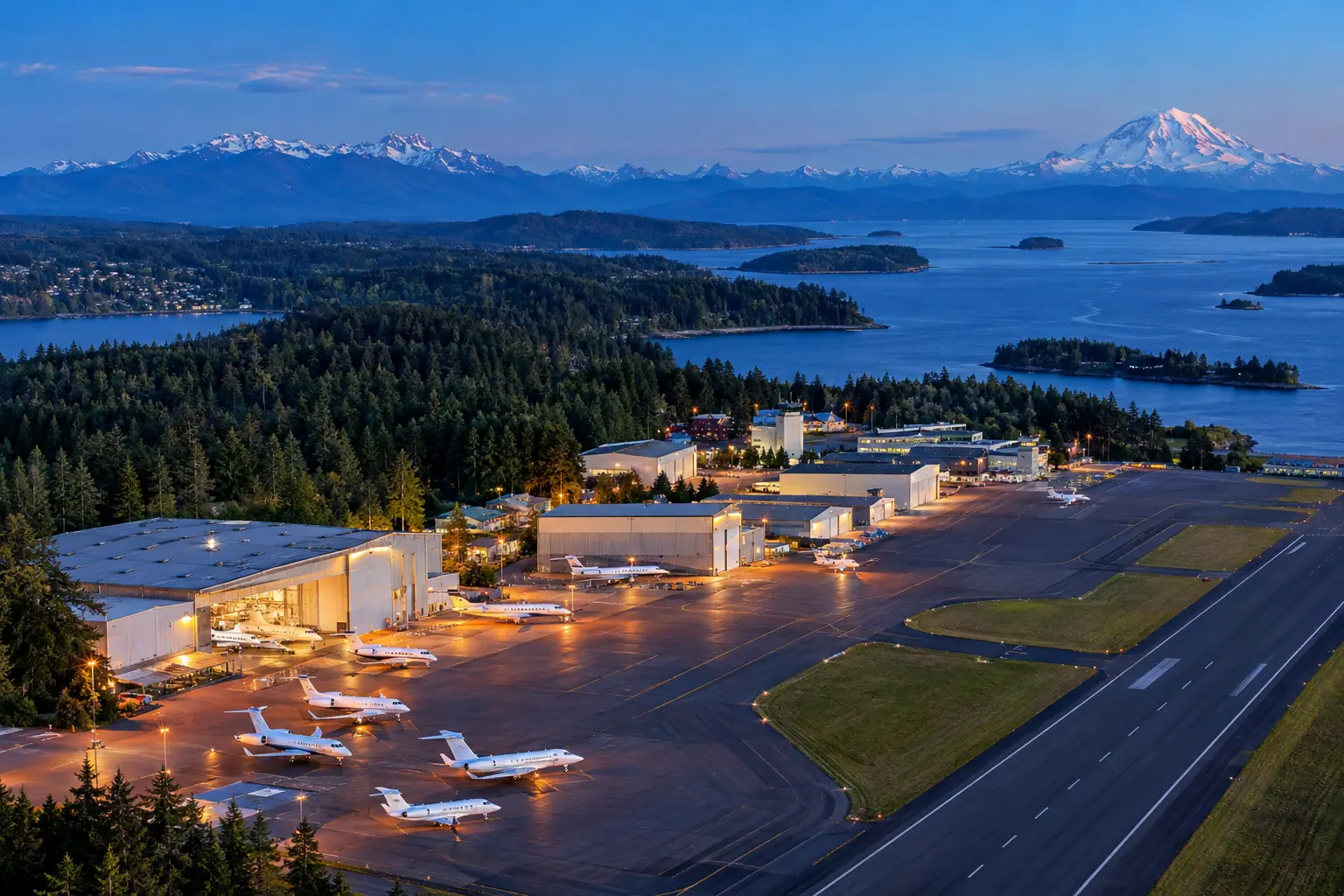
Jet charter airports Seattle
Jet charter airports Seattle travelers compare come down to four fields. Boeing Field sits 21 feet up with a 10,007-foot runway. Match your trip to the right field.
- Home
- Airports
Choosing among jet charter airports Seattle operators use comes down to runway length, elevation and how close you need to be to the city. King County International Airport - Boeing Field (BFI) is the closest field to downtown, with a 10,007-foot runway and four FBOs on site. Seattle Paine Field International (PAE) in Everett has a 9,010-foot runway at 606 feet elevation and serves the north end. Bremerton National (PWT) west of the sound offers a 6,000-foot runway, and Seattle–Tacoma International (SEA) has the longest runway at 11,901 feet but shares space with commercial traffic.
Where your flight departs depends on aircraft size and destination so ask for a side-by-side comparison before you commit. Light jets typically carry 4-7 passengers at 430 knots, while heavy jets carry 10-14 at 470 knots. Runway length matters: a 6,000-foot strip can handle many light and midsize jets but not every heavy. Density altitude also affects performance, peaking at 1,200 feet in July at BFI and 1,900 feet at PAE. Typical one-way times run 1 hour 45 minutes to San Francisco and 6 hours 8 minutes to New York in a light jet.
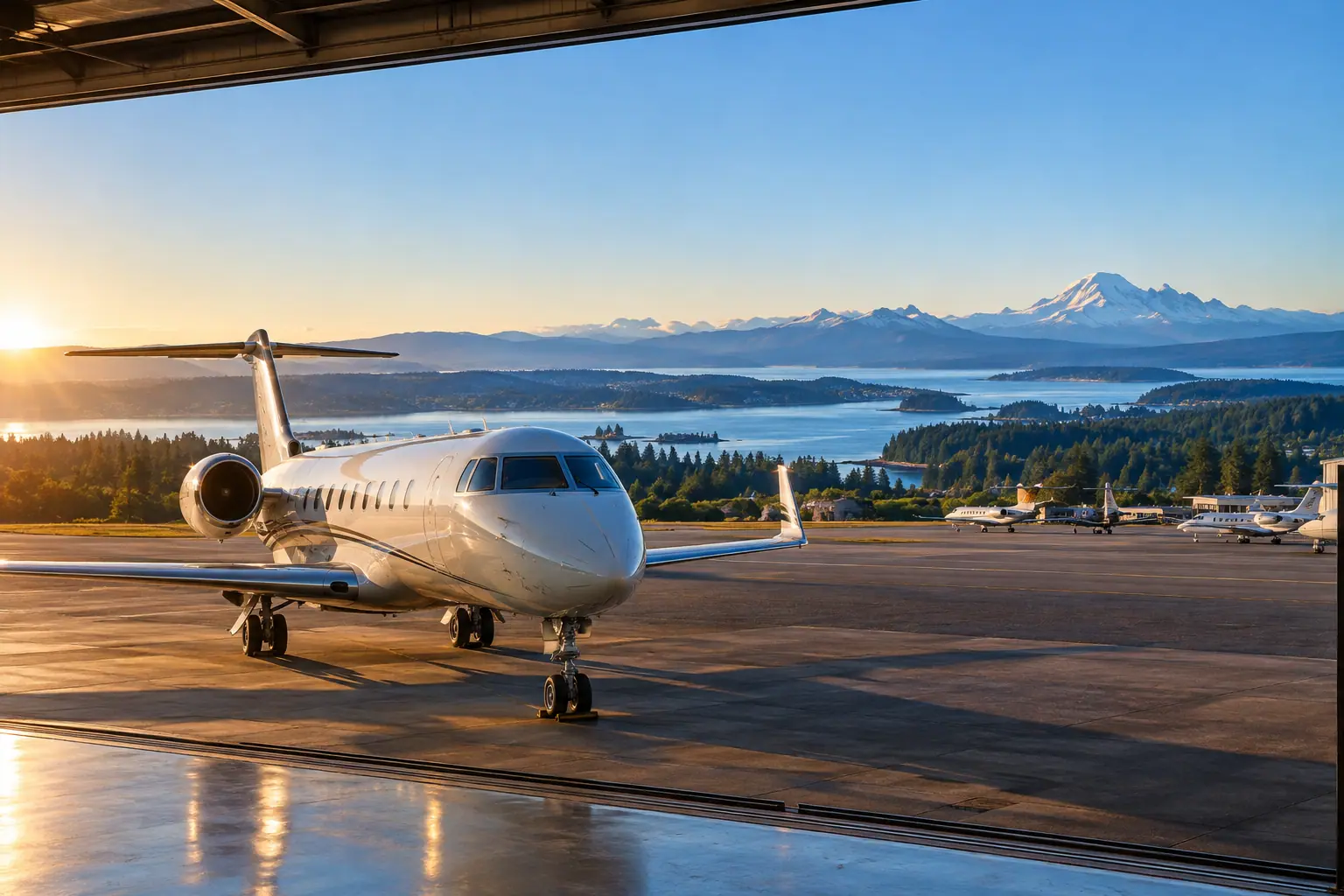
King County International Airport - Boeing Field
- KBFI code
- 21 ft field alt.
2 runways, longest 10,007 ft. 6 miles to Downtown Seattle. FBO: Modern Aviation, Signature Aviation, Skyservice Seattle, Vesper Aviation.
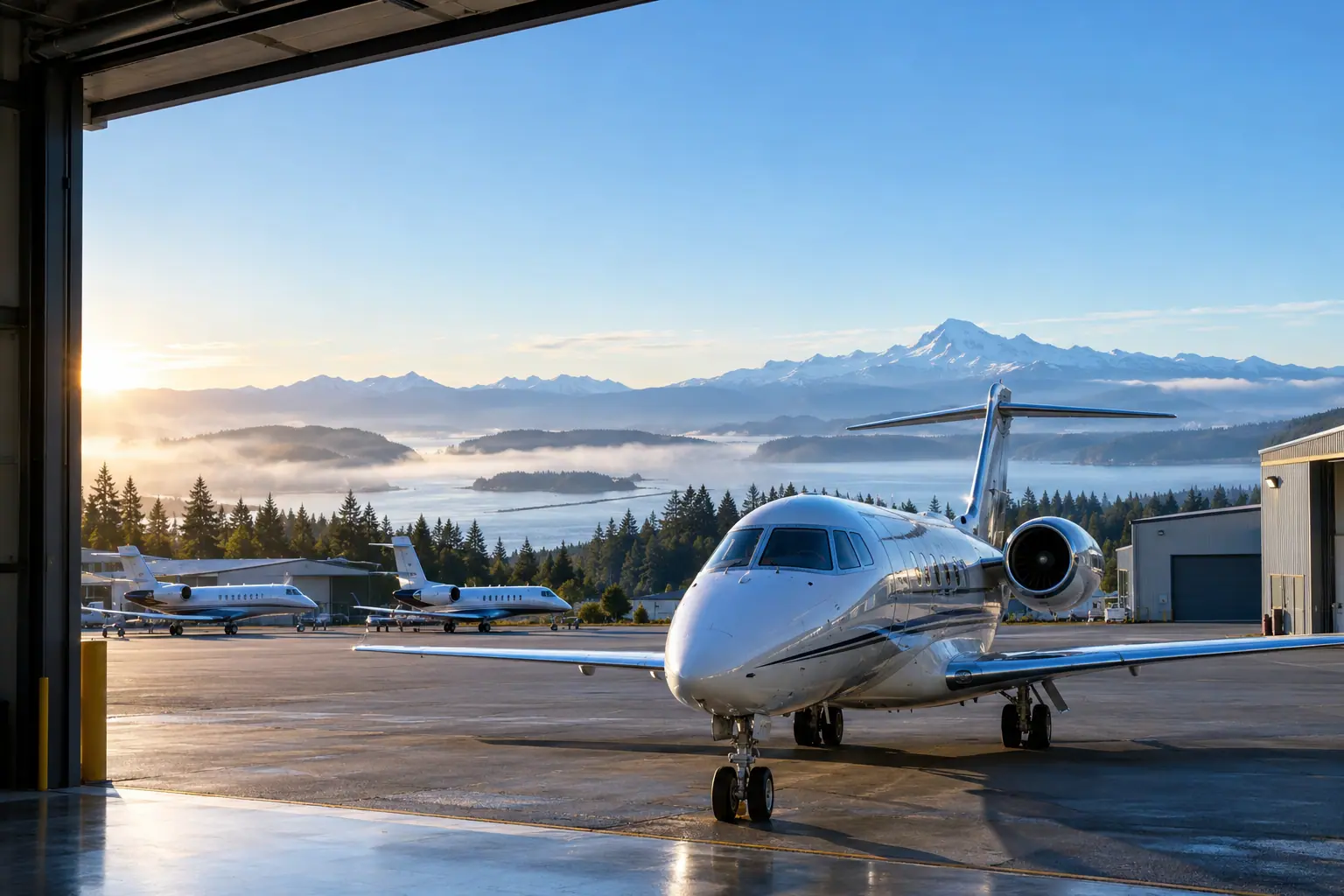
Seattle Paine Field International Airport
- KPAE code
- 606 ft field alt.
2 runways, longest 9,010 ft. 21 miles to Downtown Seattle.
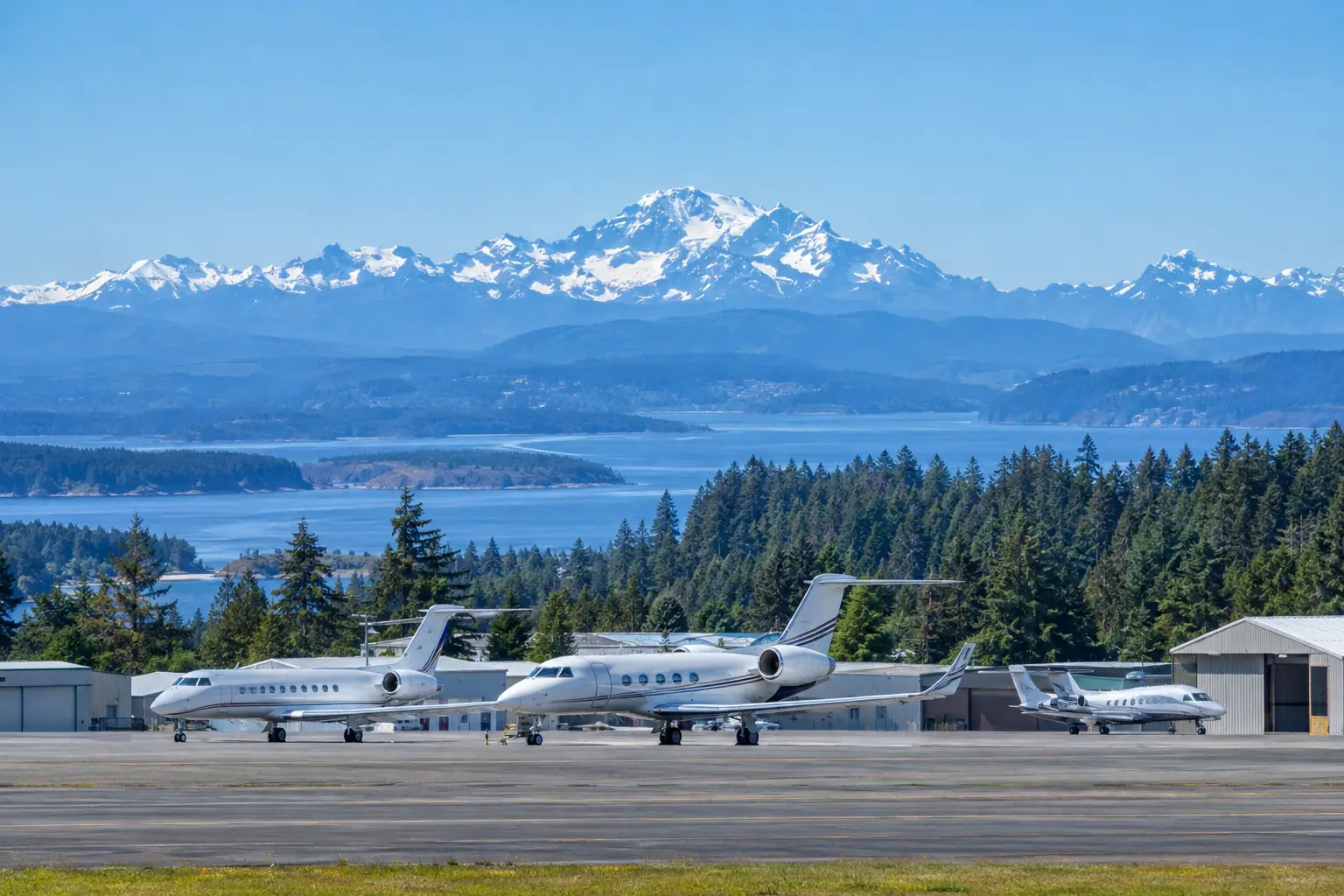
Bremerton National Airport
- KPWT code
- 444 ft field alt.
1 runways, longest 6,000 ft. 22 miles to Downtown Seattle. FBO: Avian Flight Center, Inc..
Seattle–Tacoma International Airport
- KSEA code
- 433 ft field alt.
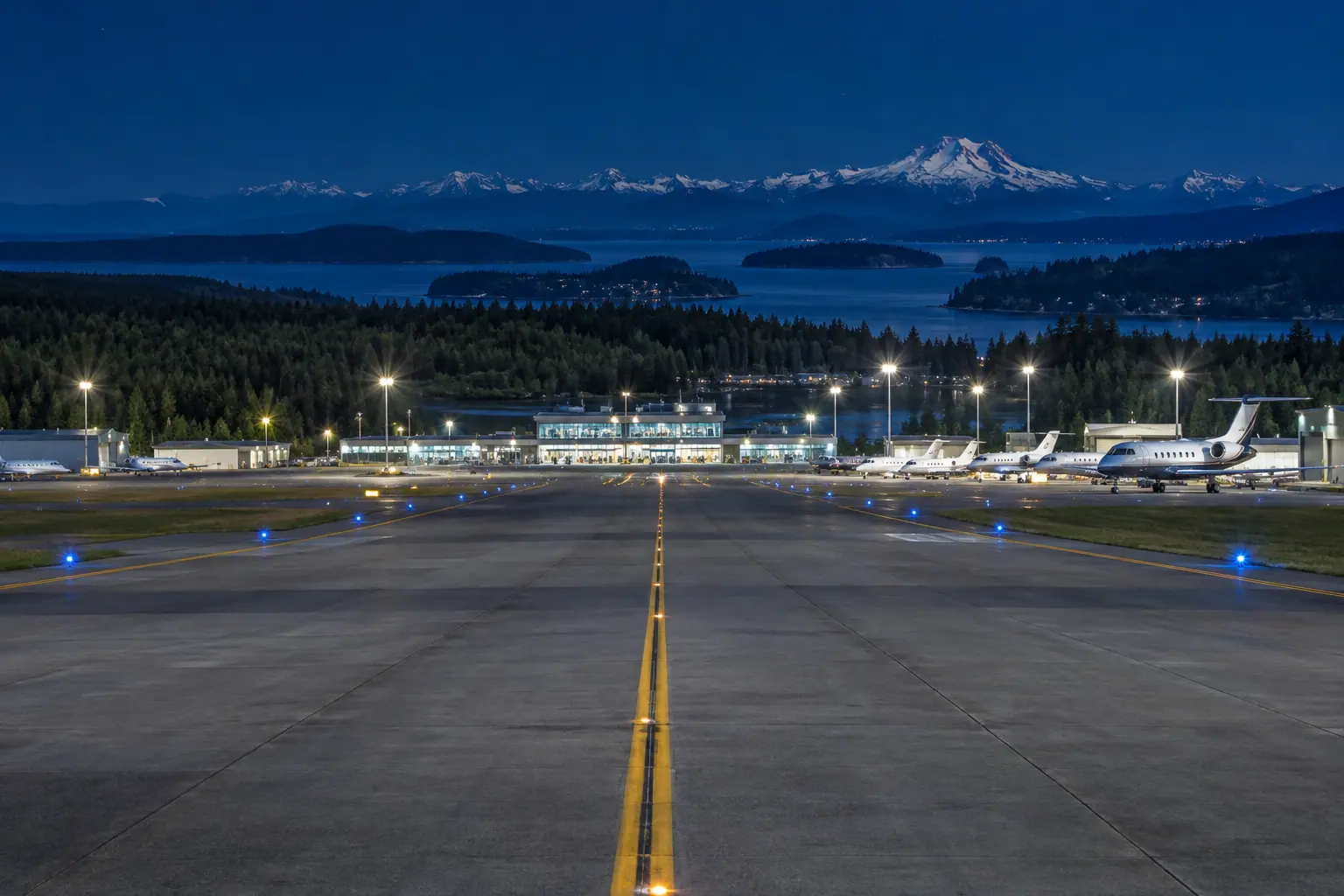
3 runways, longest 11,901 ft. 11 miles to Downtown Seattle. FBO: Signature Aviation.
Jet charter airports Seattle
Boeing Field has the closest access to downtown Seattle with a 10,007-foot runway at 21 feet elevation. Four FBOs operate there: Modern Aviation, Signature Aviation, Skyservice Seattle and Vesper Aviation. That matters when your schedule is tight or your party splits across vehicles. Paine Field is 606 feet up with a 9,010-foot runway and no FBOs listed in our data, so handling is arranged per trip. Bremerton National sits at 444 feet with a 6,000-foot runway and one FBO, Avian Flight Center. Sea-Tac has an 11,901-foot runway at 433 feet and Signature Aviation on the field. If your destination is a short hop like San Francisco at 595 nautical miles, then a light jet from Boeing Field keeps the day simple. A 6,000-foot runway at Bremerton can work for many light and midsize jets, but a heavy jet with a full load may need more. Summer density altitude at Paine Field reaches 1,900 feet in July, which stretches takeoff distance. Under DOT Part 295, we act as your agent and the flight is provided by an FAA Part 135 operator that holds operational control. For international legs, CBP clearance is arranged at the departure or arrival field as required.
| Airport | Elevation | Longest runway | To Downtown Seattle | July density altitude |
|---|---|---|---|---|
| King County International Airport - Boeing Field | 21 ft | 10,007 ft | 6 mi | 1,200 ft |
| Seattle Paine Field International Airport | 606 ft | 9,010 ft | 21 mi | 1,900 ft |
| Bremerton National Airport | 444 ft | 6,000 ft | 22 mi | 1,700 ft |
| Seattle–Tacoma International Airport | 433 ft | 11,901 ft | 11 mi | 1,700 ft |
Heat and density altitude in Seattle
July density altitude at Boeing Field is 1,200 feet and Paine Field reaches 1,900 feet, so plan for takeoff performance. At 115F, peak density altitude climbs to 1,800 feet at BFI and 2,500 feet at PAE. Those numbers matter most for heavy jets and long-range fuel loads. If you are flying a group of 10 on a warm afternoon, then a super-midsize or heavy jet may need a longer runway or a cooler departure window. Bremerton and Sea-Tac both see 1,700 feet in July, with 2,300 feet at the 115F peak.
Cooler months lower density altitude to -800 feet in January at BFI, which helps performance and can widen the aircraft options. Seattle rain is a bigger factor than heat for most of the year: January averages 18 wet days, so build buffer into ground transfers. When your trip is time-sensitive, then ask the operator about deicing and slot times at Sea-Tac, where commercial traffic is heaviest. A light jet from Seattle to Los Angeles runs 2 hours 18 minutes and $8,500 to $13,500, estimates only; final pricing depends on aircraft, crew and fees.
Questions
Which jet charter airports Seattle travelers use most?
Boeing Field (BFI) is the closest to downtown with a 10,007-foot runway and four FBOs. Paine Field (PAE) serves the north end with a 9,010-foot runway. Bremerton National (PWT) is west of the sound with a 6,000-foot runway, and Sea-Tac (SEA) has an 11,901-foot runway. The right field depends on your aircraft size, destination and ground plans. We compare all four when you request a quote.
How much does a private jet cost from Seattle to Los Angeles?
A light jet from Seattle to Los Angeles is 818 nautical miles and takes 2 hours 18 minutes, with estimates from $8,500 to $13,500. That is a light jet figure; midsize and heavy jets cost more per hour. Prices are estimates and vary with aircraft, crew, fuel and fees. We quote the full picture before you book. The same route applies in reverse from Los Angeles to Seattle.
Can a heavy jet use Bremerton National Airport?
Bremerton National has a 6,000-foot runway at 444 feet elevation, which is tight for many heavy jets at full fuel. Summer density altitude reaches 1,700 feet in July and 2,300 feet at the 115F peak, further reducing performance. If your trip needs a heavy jet, then Boeing Field or Sea-Tac is the safer choice with runways over 10,000 feet. We check performance for your specific aircraft and load.
What is density altitude and why does it matter for Seattle flights?
Density altitude is the altitude the aircraft feels given temperature and pressure. At Boeing Field it is 1,200 feet in July and 1,800 feet at the 115F peak. Paine Field is higher at 1,900 feet in July and 2,500 feet at peak. Higher density altitude means longer takeoff runs, so it shapes which jet and runway pair works. Cooler months drop to -800 feet in January at BFI.
How long is a private jet flight from Seattle to New York?
Seattle to New York is 2,080 nautical miles and takes 6 hours 8 minutes in a light jet, with estimates from $23,500 to $35,500. That is beyond a light jet's typical 1,400-nautical-mile range at full payload, so a fuel stop or a larger aircraft may be needed. A super-midsize jet at 3,200 nautical miles or a heavy jet at 4,000 nautical miles avoids the stop. We confirm range and payload for your trip.
What should I know about international flights from Seattle?
International legs such as Seattle to Cabo San Lucas at 1,583 nautical miles or Turks and Caicos at 2,848 nautical miles require CBP clearance on return. A light jet takes 4 hours 55 minutes to Cabo and 8 hours to Turks and Caicos, so the longer route usually needs a super-midsize or heavy jet. We arrange customs at the appropriate field. The FAA Part 135 operator handles the flight, and we act as your agent under DOT Part 295.